Course Syllabus
ART 265
Web Design I
Spring 2016 // M & W // 12:00–2:30pm // McCuskey 110
Professor: Phil McCollam
Office: McCuskey 103
Office hours: M & W :: 2:30–4:30pm
Email: mccollam_p@wvwc.edu
Quicklinks:
- Course Description
- Use of Canvas
- Email Policy
- Required Texts
- Required Apps
- Materials
- Learning Outcomes
- Attendance Policy
- Late / Missed Work
- Incomplete Grades
- Course Requirements
- Grading Policy
- Technology Policy
- Legal Policies
- Course Schedule
A course where special design considerations involved in engineering media for the world wide web. Design techniques and software will be used to combine this media content into an on-line interactive experience. Software environment used will be HTML / CSS.
This course is a blended learning course, requiring interaction both online and in-class. Course information and assignments will be maintained on Canvas (https://canvas.instructure.com/courses/941419) and communications will take place primarily via WVWC email.
In the event of an emergency — or if class cannot be held due to an unforeseen reason — course instruction may be maintained via the web. Options such as Skype or email messaging may be used in these situations to expand the learning environment.
Email will be the primary mode of communication outside of class. Often, if schedules change or interruptions to the class schedule occur, emails will be sent notifying the class of these alterations.
I have a 24-hour policy for responding to emails during the week (Monday – Friday) and a 48-hour policy over the weekend. I will respond as soon as I can within those given timeframes.
There is 1 required book for Web Design I. You can order your books through the bookstore, order them through Amazon (use Amazon Student for free, two-day shipping — http://www.amazon.com/gp/student/signup/info) or order them from some other resource. Finding used copies is more than acceptable:
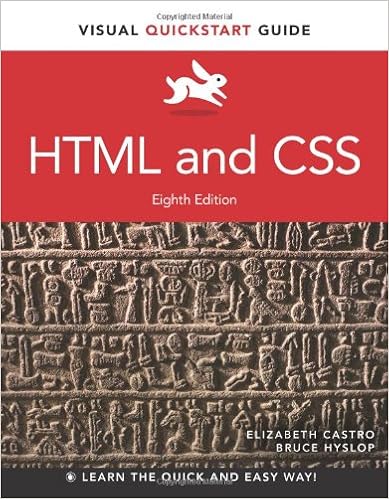 |
HTML and CSS: Visual QuickStart Guide (8th Edition) by Castro and Hyslop Available from Amazon: http://www.amazon.com/HTML-CSS-Visual-QuickStart-Edition/dp/0321928830 |
Recommended Text:
This book will supplement the topics covered in class and enhances the content of the required text. It is NOT required for the course, but will act as an excellent reference for self-guided and more complex projects.
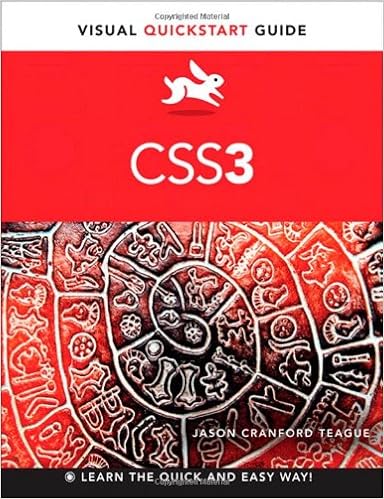 |
CSS3: Visual QuickStart Guide (6th Edition) by Cranford Teague Available from Amazon: http://www.amazon.com/CSS3-Visual-QuickStart-Guide-Edition/dp/0321888936 |
Since this is a web design class, most of our materials will be computer applications that are available in the lab or as free downloads. There are equal options for both Mac and PC:
Mac:
-
TextEdit — a basic text editor, comes on every Mac install
NOTE: You must go through a few steps to prepare TextEdit for writing / editing HTML and CSS. Follow this tutorial before the start of the first class to get it up and running: http://www.gottheknack.com/a__general/textEditPreferencesSettings/textEditPreferencesSettings.html
Windows:
- Notepad — a basic text editor, comes on every Windows install; make sure that you have a shortcut for it
Windows & Mac:
- Brackets with Extract — a free, advanced text editor (http://brackets.io/)
- FIRST DAY OF CLASS: FileZilla — a free FTP client application (https://filezilla-project.org/download.php)
- Google Chrome — a free browser that we'll be using for testing and editing our sites (https://www.google.com/intl/en/chrome/browser/desktop/index.html)
- Ripple Emulator (beta) — free extension for testing our sites that must be installed in Chrome (https://chrome.google.com/webstore/detail/ripple-emulator-beta/geelfhphabnejjhdalkjhgipohgpdnoc?hl=en)
Required Materials:
Although the assignments and in-class walkthroughs will be completed entirely on the computer, it is requested that all students purchase an external hard drive and USB flash drive for backing up and transferring their files between computers. The type of drives you purchase are up to you; below are personal suggestions:
- Suggested hard drive: WD My Passport Ultra Portable External USB 3.0 Hard Drive, 1TB http://www.amazon.com/Passport-Ultra-Portable-External-Drive/dp/B00E83X9P8/ — This drive will work with both Mac and Windows computers and has enough space to save and archive all of your files for this course. Graphic Design and Art students will also be able to keep this drive and use it in all future courses as well. Also available in a 2TB option.
It is suggested that if you purchase the My Passport drive, you also purchase a carrying / protective case such as this: AmazonBasics Hard Carrying Case for My Passport Essential http://www.amazon.com/AmazonBasics-Hard-Carrying-Passport-Essential/dp/B003LSTD38/
- Suggested USB flash drive: SanDisk Cruzer 128GB USB 2.0 Flash Drive http://www.amazon.com/SanDisk-Cruzer-128GB-Drive--SDCZ36-128G-B35/dp/B00TKFCYP0/ — A versatile drive that can be used on both Mac and PC operating systems. This is a 128GB drive, but there are various sizes of drives available, from 4GB to 512GB and up. A flash drive can be used to store and transfer your files for this and other courses, and it acts as a quick and portable option when the external hard drive may be in use or too cumbersome.
During the semester, students will practice basic design principles and improve hand skills. By the end of the semester, they will be able to demonstrate the following:
- Properly utilize graphic design terminology through open critique and discussion.
- Create final works by combining handmade and digital processes.
- Demonstrate the basic professional workflow, working from concepts to final output.
- Learn about the design profession by interviewing practicing creatives.
- Develop technical skills through online courses in professional design software.
Class Attendance/Participation:
Graphic Design I is a class that relies on participation, feedback, and interaction with peers and the instructor, which cannot be duplicated outside of class. Students who miss class are putting both themselves and their classmates at a disadvantage. If a student misses a class, it is assumed they had good reason to do so.
Therefore, I do not distinguish between excused and non-excused absences. Students are responsible for completing any work missed during their absence and for obtaining pertinent class notes & materials.
You must come to class on time and be prepared to work. Class roll is taken everyday at the start of class (8:30am). Class begins promptly as scheduled. Leaving class early results in an absence for the day no matter how much time was spent in class that day.
The day's attendance can be checked on Canvas.
For every session of class, you have the opportunity to earn a P, L, U or A.
- P = Present, on-time, and ready for class (+2 points)
- L = Late for class/ late returning from a break / present but unprepared for class (does not have the required materials at class) (-1 point)
- U = Present but unprepared for class (does not have the required materials at class) (-1 point)
- A = Absent / left class early (0 points)
This is an intense course and as such, only 3 absences are allowed. As mentioned above, this includes all absences (serious health conditions, family emergencies, legal requirements, religious observance, etc). If you go over 3 absences for any reason, your overall grade will be affected as follows:
- 4 absences = Drop 1 letter grade - your highest achievable grade is a B+
- 5 absences = Drop 2 letter grades - your highest achievable grade is a C+
- 6 absences = Drop 3 letter grades - your highest achievable grade is a D+
- 7 absences = Automatic failure (do not come to class anymore)
Note that 3 Lates equal 1 Absent
Example: If you have an A in the course, but have missed 2 class meetings and have 7 late arrivals, you would receive a final grade of B.
If you are absent for any reason, contact a classmate to find out what you missed. I will expect you to be prepared for the next class meeting like everyone else. If you have trouble attending class, please discuss your attendance problems privately with me after class. Clear communication before it becomes a problem is key to solving these issues.
Also, if you are absent, you will receive a zero on any assignment(s) that are completed during that class meeting.
It is strongly suggested that you save your 3 absences for emergency use only (when you become sick or injured, a death in the family, etc).
Check the status your your attendance regularly if you are concerned. If you come to class late, make sure it's not marked as an absence. This is your responsibility, not the instructor's.
Note: Students who anticipate the necessity of being absent from class due to observation of a major religious observance must provide notice of the date(s) to the instructor, in writing, by the second class meeting.
Note: If you are sick, DO NOT come to class! Since we will spend much of our time working with multiple peers in-class, there is a high probability of one-to-one contact. Thus, the possibility of spreading illness is high. If you are feeling ill, use your one absences. If it becomes a chronic issue or if you are told by a doctor to avoid coming to class for an extended period of time, you must notify the instructor before missing subsequent classes.
All work must be submitted on time and there are no late exceptions. Complete all assignments by the due date. Late assignments are not accepted. If you will not be able to make it to class on the day an assignment is due, send it to class with a friend / sibling / relative / etc. You are responsible for the information missed by an absence. Extreme circumstances need to be reported to mccollam_p@wvwc.edu ASAP.
If there is severe weather and you are unable to make it to campus, you can email photos documenting the completed assignment. The photos must be received before the start of class. Email notifications sent after the start of class or after class will cause the assignment to be considered late. Projects that are incomplete or unfinished when documentation is created will be considered late.
Incomplete grades will not be offered at the end of the semester unless the following criteria are met:
- student is passing the class at time of incomplete status request
- student has adequately completed course materials before the incomplete status request
- student has a record of regular, on-time and prepared attendance before the incomplete status request
- student has adequately completed 90% of assignments before the incomplete status request
In the event that an incomplete grade is granted by the professor, it will be the student's responsibility to complete the remainder of the coursework before the start of the next academic semester in order to receive credit. If coursework remains incomplete, a grade of F will be applied to all unfinished work and the final grade will be submitted to the Registrar's office.
This course will involve a variety of project types including self-directed projects; technical proficiency tests; and professional production. Assignments will include meetings, discussions, readings and meeting hard deadlines.
The following items are to be expected of / by all students:
- Utilize in-class time effectively.
- Be prepared to spend as much time outside of class as you feel is necessary.
- Watch deadlines and be aware of when things are due. Failure to have proper supplies or completed assignments will result in a lower attendance grade for the day.
- Work independently outside of class.
- Ask questions early if something is unclear.
- Develop intelligent, informed decisions when producing work.
- Continue research and exploration outside of scheduled class meetings.
- Maintain a level of professionalism both inside and outside the classroom.
- Assignments will be graded when due and late assignments will receive zero credit unless arrangements have been made prior to the due date.
Requirements for Completion:
Simply turning in an assignment does not guarantee a passing grade will be received. Each assignment will be graded on the minimum following criteria, and point values for each will vary depending on the scope of the assignment:
- Craft – the technical quality of the final product
- Assignment Requirements – the ability of the final product to meet all requirements as outlined in the assignment
- Timeline – meeting all expected deadlines and turning in the completed assignment at the expected due date
- Critical Reflection – completion and participation in critique, including in-progress and final critiques at different stages of the process
Letter grades will be given for each major assignment based on a combination of the above criteria. Grade percentages are NOT rounded, and descriptions of grades are as follows:
SUPERIOR: 100% – 93% (A) // 92.9% – 90% (A-)
- Scholarship – Strong, exceeding requirements of instructor
- Initiative – Contributions exceeding the assignment, showing independent resourcefulness
- Attitude – Positive benefit to class
- Cooperation – Leading all group activities, constant and spontaneous
- Individual Improvement – Marked and growing
GOOD (ABOVE AVERAGE): 89.9% – 88% (B+) // 87.9% – 83% (B) // 82.9% – 80% (B-)
- Scholarship – Accurate and complete, meeting all requirements of instructor
- Initiative – Good when stimulated by some desireable achievement
- Attitude – Proper and beneficial to group
- Cooperation – Good in group work
- Individual improvement – showing marks of progress and responding to stimulation
OKAY (AVERAGE): 79.9% – 78% (C+) // 77.9% – 73% (C) // 72.9% – 70% (C-)
- Scholarship – Barely meeting assignments and showing evidence of need of encouragement
- Initiative – Uncertain and apparent only at times
- Attitude – Generally neutral but not objectionable
- Cooperation – Not positive nor very effective and irregular
- Individual Improvement – Very ordinary, definite marks lacking
BELOW AVERAGE (PASSING): 69.9% – 68% (D+) // 87.9% – 63% (D) // 62.9% – 60% (D-)
- Scholarship – not meeting all assignments and requirements of instructor
- Initiative – lacking
- Attitude – Indifferent
- Cooperation – Just fair at times and lacking at other times
- Individual Improvement – not noticeable
FAILING: < 60% (F)
- Work unsatisfactory and is a failing grade and hence not defined.
Use of Computers and Cell Phones:
The use of tablets and phones during class time is prohibited. Usage of such devices between the start and end of class will result in a the loss of one attendance point for day. If usage becomes an ongoing problem, I will instate a location within the classroom to leave phones at the start of class.
MP3 players can be used during work time, but I have a one earbud policy: if you want to listen to your own music, you can do so, but you must only use one earbud so that you will be able to hear communications which may occur. If your phone is your MP3 player, then there will be a strict no-texting / no-calls policy enforced.
Statement of Social Justice/ Non-Discrimination Policy:
The College fully subscribes to the development of individuals as worthy persons who should be nurtured to their fullest potential regardless of race, color, creed, religion, age, gender, marital status, sexual orientation, veteran status, genetic predisposition, national or ethnic origin, or physical or mental disability.
The College’s Policy Regarding Students with Disabilities:
West Virginia Wesleyan College ensures that no qualified person shall, by reason of a disability, be denied access to, excluded from participation in, or denied the benefits of any program or activity operated by the College or be subjected to discrimination under any of its programs or activities. The College shall make reasonable accommodations to the known limitations of an otherwise qualified student with a disability to enable the qualified student with the disability to have equal access to educational opportunities, programs and activities. Section 504 of the Rehabilitation Act of 1973 [29 U.S.C. 794(a)] and Americans with Disabilities Act of 1990 (ADA) [42 U.S.C. § 12101, et seq.].
I concur with the College’s commitment to social justice and expect to foster a nurturing learning environment based upon open communication, mutual respect, and nondiscrimination. Any suggestions as to how to further such a positive and open environment in this class will be appreciated and given serious consideration.
If you are a person with a disability and anticipate needing any type of accommodation in order to participate in this class, please advise me and make appropriate arrangements, according to our Student Handbook http://www.wvwc.edu/Students/pdf/StudentHandbook.pdf with the Director of the Learning Center (473-8499).
Academic Integrity:
I follow the academic integrity policy as stated in the current WVWC Student Handbook. If you violate this policy (e.g., cheating, plagiarizing, submitting duplicate copies of work in different courses without instructor permission, selling or purchasing assignments, etc.), you will be subject to disciplinary action. A written letter will be sent to the Dean of Academic Affairs and will become part of your College and school/departmental files and may result in further disciplinary action by the College. Please note that unless specifically stated by the instructor or in the requirement outline all work shall be the original work of the student that has not ever been submitted to meet the requirements of any activity/assignment in this course or any other course.
Course Schedule
Note: This schedule is tentative and may change over the course of the semester. There may be an occasion that would require class to be cancelled. In this event you will be informed via email and other assignments and/or activities will be substituted for the in-class participation and activity(ies).
Course Summary:
| Date | Details | Due |
|---|---|---|