Course Syllabus
ENGLISH V01A: ENGLISH COMPOSITION ONLINE
COURSE DESCRIPTION: This transfer-level course is designed to help you develop and expand your college level writing skills.  It is intended to improve your ability to plan, write, and revise essays, read critically, document sources accurately while finding and interpreting relevant information, apply peer and instructor feedback to the revision process, and take timed essays effectively. You will learn how to write coherent, well developed, and unified expository and argument essays, to summarize and analyze published ideas, and to conduct research and write a research paper. The instructor will evaluate you on your participation during class discussions, your collaborative work (i.e. journal entries, group activities, quizzes, workshops in grammar, syntax, and mechanics -- spelling, punctuation, vocabulary building -- and in revision and editing, reading comprehension questions, and other writing exercises), take-home essays, in-class timed essays, a final research paper, and attendance. In this class, challenge yourself to go beyond “that’s good enough” in your writing and strive to surprise and delight yourself with the quality of your work.
STUDENT LEARNING OUTCOMES: Upon successful completion of the course the student will be able to:
- CSLO-1: Write coherent, thesis-driven academic prose with well-developed supporting paragraphs and a conclusion.
- CSLO-2: Write 50-minute timed essays of at least two pages in response to a written prompt (expository writing). Essays should include a thesis, focused and detailed body of support, and a conclusion, and should be free of distracting sentence-level errors.
- CSLO-3: Students will employ sound reasoning.
- CSLO-4: Argue a researched perspective on issues of professional, personal and/or social significance by gathering, evaluating, and synthesizing sources in a correctly documented paper.
This course also targets Core Competencies: to read, retain, and apply published ideas, to write clearly and accurately, to find and interpret relevant information, to document sources of information, and to apply feedback to improve performance.
COURSE OBJECTIVES: Upon successful completion of this course, the student will be able to demonstrate the following measurable skills and abilities:
- Read, analyze, and evaluate a variety of primarily non-fiction texts for content, context, and rhetorical merit with consideration of tone, audience, and purpose.
- Apply a variety of rhetorical strategies in writing unified, well-organized essays with arguable theses and persuasive support.
- Develop varied and flexible strategies for generating, drafting, and revising essays.
- Analyze stylistic choices in their own writing and the writing of others.
- Write timed essays in class exhibiting acceptable college-level control of mechanics, organization, development, and coherence.
- Integrate the ideas of others through paraphrasing, summarizing, and quoting without plagiarism.
- Find, evaluate, analyze, and interpret primary and secondary sources, incorporating them into written essays using appropriate documentation format.
- Proofread and edit essays for presentation so they exhibit no disruptive errors in English grammar, usage, or punctuation.
REQUIRED TEXTS (All texts are available at the campus bookstore)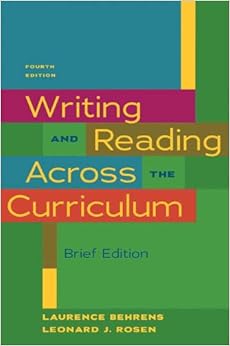
- Behrens, Laurence and Leonard J. Rosen. Writing and Reading Across the Curriculum (WRAC), Brief Edition. 4th Edition. (New York: Addison Wesley Longman), 2010. ISBN-10: 020500069X
- An American language dictionary of your choice
TURNITIN.COM: For all required essays, our course website automatically submits all essay to Turnitin.com, an automated system to quickly and easily compare each writer's assignment with billions of web sites, as well as an enormous database of student papers that grows with each submission. After each  assignment is processed, the writer and teacher will receive a report from Turnitin.com that states if and how another author’s work was used in the assignment. For a more detailed look at this process, visit http://www.turnitin.com.
ACADEMIC HONESTY: As a member of this academic community, you are expected to practice honesty in all your academic pursuits. Respect for others’ intellectual efforts is at the heart of such honesty. Whether direct quote, paraphrase or summary, borrowing from any source—spoken, written or electronic—must be acknowledged through proper citation. Plagiarism will not be tolerated. Using someone else’s words or ideas without giving that person credit is a serious form of academic dishonesty and will not be tolerated or overlooked.
Academic dishonesty can take several forms including:
- Handing in something written for a different class
- Copying from another student’s paper or test
- Copying sentences or phrases from a source (including websites) without properly citing that information. (ex. Copying and pasting information from Wikipedia without quotation marks or a citation.)
Plagiarism Policy: Any work you turn in is expected to be your own. a) Any act of accidental plagiarism will result in an “F” for the assignment with the option to revise for a passing grade b) Acts of deliberate plagiarism will result in a ZERO for the assignment, and I will report all incidents of plagiarism to the division dean for further disciplinary action.
EDUCATIONAL ASSISTANCE CENTER: If you have a disability that may require accommodations, please let me know as soon as possible so that your learning needs may be appropriately met. If you have not already done so you will also need to contact the Educational Assistance Center at 654-6300 to receive authorization for your accommodations. Their office is located in the Administration Building, just across from the Student Services Center.
Course Summary:
| Date | Details | Due |
|---|---|---|